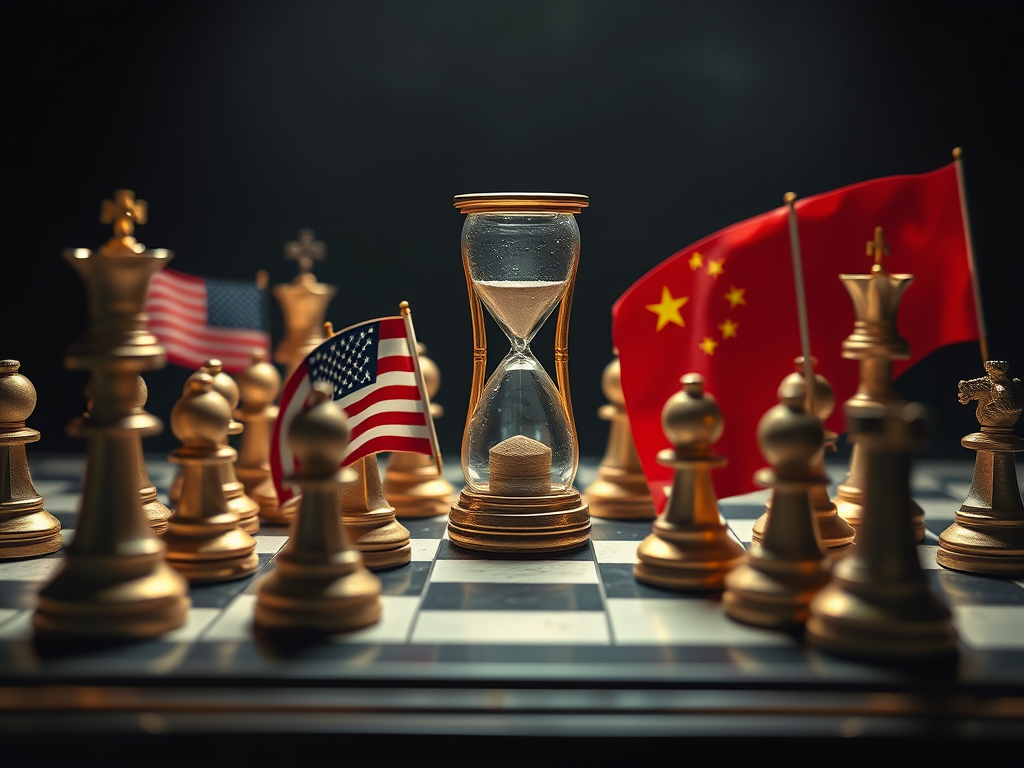
Time, Pressure, and the Strategy of Not Fighting
Tom Raquer
Lt. Col. (Ret.), U.S. Air Force
Southeast Asia Foreign Area Officer
Writing for First Turning Strategists
Part IV — Who Benefits from Pressure
PREVIEW
If war becomes domestic pressure for the United States, the next question is simple:
Who benefits from that pressure?
The United States is focused on how to fight this war.
China is focused on what the war produces over time.
That difference is not analytical.
It is strategic.
A DIFFERENT STRATEGIC FRAME
There is a Chinese phrase that captures the approach:
Trading with the sword in hand.
It describes a method:
- Keep ability
- Avoid premature confrontation
- Use the instability created by others
- Build an advantage over time
This is not passivity.
It is controlled patience.
TIME AS A VARIABLE
In U.S. strategic thinking, time is often treated as a constraint.
Something to compress.
Something to manage.
Here, time is a tool.
The longer a conflict runs, the more it produces:
- Energy volatility
- Supply chain disruption
- Financial strain
- Political pressure
These effects do not peak.
They accumulate.
ACCUMULATION, NOT DECISION
U.S. strategy tends to focus on events:
- Battles
- Operations
- Negotiations
This approach focuses on position.
Small advantages that build.
Structural shifts that hold.
The outcome is not decided in a moment.
It forms over time.
PRESSURE WITHOUT ENGAGEMENT
China does not need to intervene directly.
This system is already under stress.
The United States absorbs the cost.
Resources are consumed.
Political pressure builds.
Alliances start to strain.
At the same time:
- Capital looks for stability
- Supply chains look for reliability
- Production consolidates
China positions itself inside that movement.
STRUCTURE OVER TACTICS
The advantage is not on the battlefield.
It is structural:
- Industrial depth
- Supply chain integration
- State coordination
- Energy diversification
These do not decide short wars.
They matter in long ones.
A DIFFERENT WAY OF THINKING
U.S. strategy looks for a resolution.
This approach manages conditions.
Less emphasis on decisive victory.
More emphasis on shaping the environment.
CENTER OF GRAVITY
From this perspective, the centre of gravity remains internal:
- Economic stability
- Political cohesion
- Alliance durability
A prolonged conflict applies pressure to all three.
Without confrontation.
And in a constitutional republic, that pressure does not stay external.
It feeds back into public consent.
CREDIBILITY AND STRATEGIC ALIGNMENT
Recent public statements about negotiations and strategic intent do not fully align with observable conditions in the conflict environment.
That gap matters.
In war, credibility is not a messaging issue.
It is a structural one.
When stated policy diverges from reality, public trust weakens.
And in a constitutional republic, that trust is not peripheral—
It is part of the centre of gravity itself.
THE STRATEGIC IMPLICATION
This is the key asymmetry.
The United States is engaged in managing the conflict.
China is positioned to gain from its effects.
One side must sustain:
- cost
- cohesion
- credibility
The other side observes how those variables evolve.
Over time, pressure does not stay evenly distributed.
It concentrates.
CONCLUSION
This is not a war China needs to win.
It is a system already producing pressure.
One side is engaged in the fight.
The other is positioned to gain from the network’s evolution.
And in prolonged conflict—
Advantage does not always go to the side that acts.
It often goes to the side that can wait.
Because the decisive variable is not always force.
It is alignment.
Strategist’s Question
If pressure is the mechanism—and time is the amplifier—
Which side is better positioned to endure what this war produces?
KEY POINTS
- Time functions as a strategic resource
- Pressure can create an advantage without direct engagement
- Structural position outweighs short-term outcomes
- Long conflicts favour patient actors
- Internal cohesion becomes the decisive variable
SOURCES
- China International Capital Corporation (translated analysis)
- International Energy Agency
- Carl von Clausewitz — On War
- Sun Tzu — The Art of War
BIO
Tom Raquer
Lt. Col. (Ret.), U.S. Air Force
Southeast Asia Foreign Area Officer
Tom Raquer writes on strategy, legitimacy, and the internal foundations of power.
Leave a Reply The Essential American Citizen Thanks you!