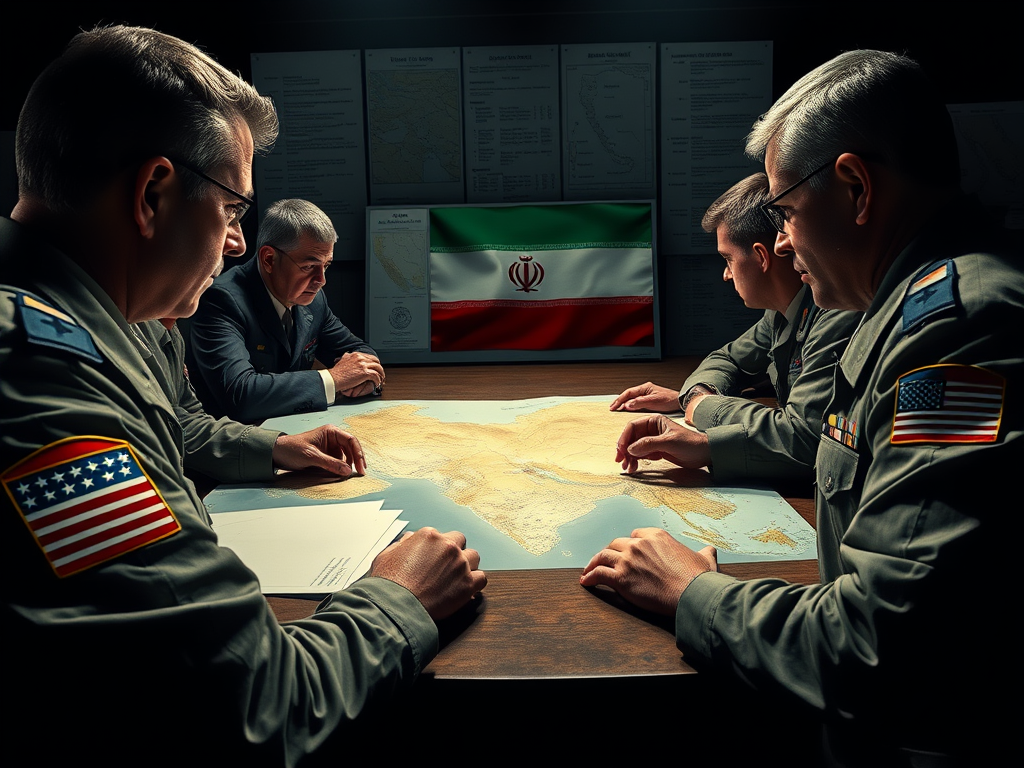
Strategy often fails not because power is lacking, but because the analogy guiding it is wrong. Treating Iran like Venezuela is a dangerous misread. It assumes sustained pressure will fracture elites and produce a compliant successor. Iran’s authority rests on dense clerical, security, and ideological institutions, as well as a civilizational legitimacy that survives leadership shocks. Policymakers should stop applying convenient historical templates and instead interrogate the deeper institutional and cultural forces that actually sustain regimes.
10 March
False Analogies in Strategy
Why Iran Is Not Venezuela
Preview
Strategy often fails not because power is insufficient, but because the analogy guiding it is wrong. One of the most misleading analogies in the current strategic debate is the comparison between Iran and Venezuela.
From the series:
After the Winter — Collapse, Spring, and the New First Turning
Tom Raquer
Lt. Col. (Ret.), USAF • Southeast Asia Foreign Area Officer
Publish Date: March 10, 2026
The Danger of Strategic Analogies
Strategy often fails not because power is insufficient, but because the analogy guiding it is wrong.
Strategists often rely on historical analogies to interpret emerging crises. Analogies simplify complex events by offering familiar patterns that make unfamiliar situations easier to understand.
But when the analogy is flawed, the strategy built upon it can quickly drift into miscalculation.
One such analogy increasingly appears in discussions of Iran: the suggestion that Iran will follow Venezuela’s political trajectory.
At first glance, the comparison seems plausible. Both countries face Western sanctions, keep adversarial relations with the United States, and have faced sustained economic pressure.
Yet beneath those superficial similarities lie profoundly different political structures.
The Venezuela Model
In many policy discussions, the Venezuela analogy rests on a simple strategic expectation.
Sustained economic pressure weakens the regime.
Elite divisions deepen within the ruling circle.
Eventually, the leadership fractures, producing either regime collapse or a more compliant successor government.
Under this model, regime transformation does not need invasion or occupation. Pressure alone gradually destabilizes the leadership while leaving the broader state structure intact.
This approach assumes that political authority in the targeted state ultimately depends upon elite cohesion around a central leader.
That assumption may sometimes apply to personalist regimes.
But it does not accurately describe the structure of the Iranian state.
Iran Is Not a Personalist Regime
Venezuela’s political system has historically revolved around personalist leadership and patronage networks.
Iran’s political system is fundamentally different.
The Islamic Republic rests on a complex institutional structure built after the 1979 revolution. Political authority is distributed across clerical institutions, ideological organizations, and powerful security structures embedded throughout the state.
The Islamic Revolutionary Guard Corps is among the most important of these institutions. It serves as a military force. It is also a political and economic pillar of the regime.
This institutional depth means the framework was designed to survive leadership crises and external pressure.
Removing or weakening a single leader does not necessarily destabilize the regime.
Indeed, external pressure may reinforce internal cohesion by strengthening the regime’s narrative of resistance to foreign intervention.
The Civilizational Factor
The deeper problem is not simply institutional. It is civilizational.
The historian Fernand Braudel argued that history operates on multiple time scales. Political events unfold quickly, but civilizations evolve slowly over centuries. These deeper historical structures shape political life far more profoundly than short-term political arrangements.
Civilizations, in Braudel’s view, persist through changing governments and political orders.
This insight was later developed by Samuel P. Huntington, who argued that cultural and civilizational identities often form the deepest fault lines in international politics.
Political systems grounded in long historical traditions derive legitimacy from those traditions.
External pressure rarely transforms those foundations.
The Lesson of Afghanistan
Recent history provides a clear illustration of this problem.
After the fall of the Taliban, the United States invasion of Afghanistan took place. The United States and its allies then attempted to construct a constitutional republic in Afghanistan.
For two decades, the Afghan state existed largely under Western military protection.
Yet when that external support receded, the political system collapsed, and the Taliban rapidly returned to power.
The lesson was not simply institutional failure.
It served as a reminder. Externally designed political systems can’t easily replace political legitimacy. Such legitimacy is rooted in deep cultural and historical traditions.
The Strategic Misreading
Much of the Western strategy toward Iran rests on an implicit assumption. It assumes that enough pressure will eventually produce a more compliant Iranian leadership.
But if civilizational legitimacy forms the deeper foundation of the Iranian political system, that assumption becomes questionable.
Political systems rarely transform simply because external powers wish them to.
Strategies built on that expectation risk misunderstanding the nature of the regime they seek to influence.
The Republican Constraint
For the United States, the issue extends even further.
As argued in yesterday’s essay on the centre of gravity of a republic, American strategy relies on legitimacy. This legitimacy is granted by its own citizens. This legitimacy is crucial for its success.
Strategies that assume prolonged confrontation or regime transformation abroad need sustained domestic political support.
Without that legitimacy, even powerful states can find their strategic endurance limited.
In a constitutional republic, the centre of gravity lies abroad. It also resides within the political cohesion of the republic itself.
Closing Reflection
The temptation to treat Iran as another Venezuela is clear. This approach reflects a deeper habit in Western strategy. There is a belief that political systems will ultimately yield to pressure.
History suggests otherwise.
A successful strategy begins not with analogies but with a precise understanding of the political systems involved.
And in this case, the differences between Iran and Venezuela are far more important. The deeper civilizational forces shape political legitimacy. These aspects overshadow their superficial similarities.
Question for Readers
When confronting complex geopolitical crises, should strategists rely on familiar historical analogies? Or should they first examine the deeper historical and civilizational structures that sustain political systems?
Leave a Reply The Essential American Citizen Thanks you!