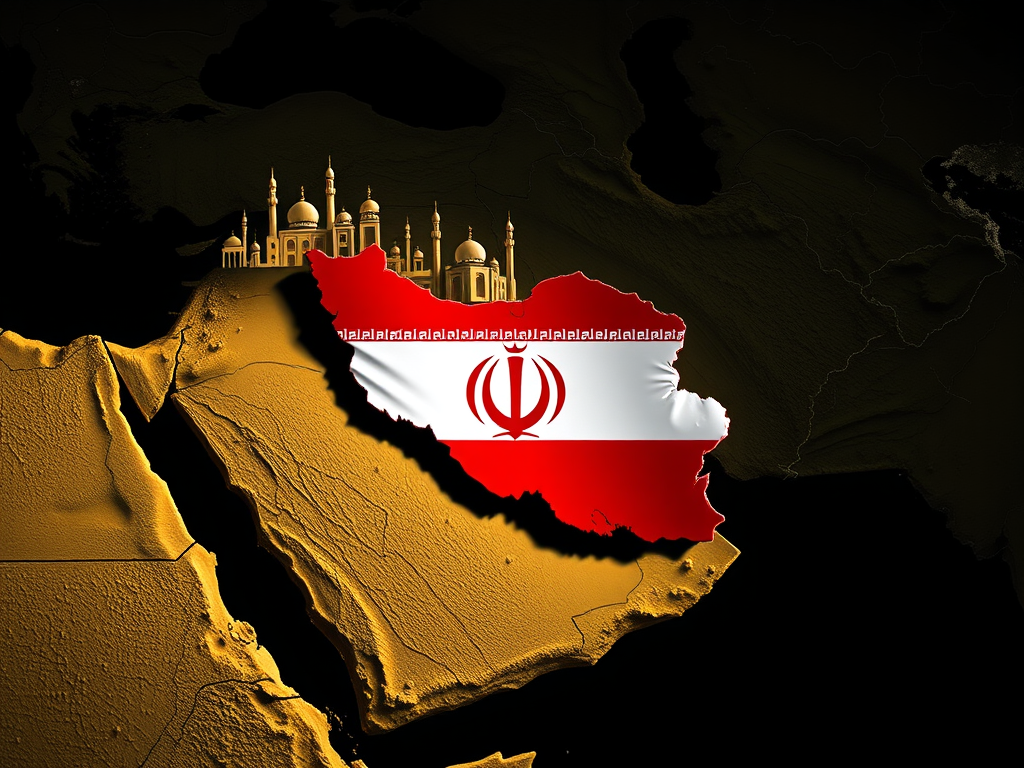
Iran, Geopolitics, and the Sunni–Shia Divide
Tom Raquer
Lt. Col. (Ret.), USAF • Southeast Asia Foreign Area Officer
From the series:
After the Winter — Collapse, Spring, and the New First Turning
Published: March 15, 2026
The war with Iran is not yet a Sunni–Shia war.
But history suggests that conflicts in the Middle East rarely stay purely geopolitical. If the current confrontation widens, it will influence the deeper sectarian fault line of the Islamic world. This once again shapes the struggle for regional power.
Key Points
• The current confrontation with Iran is primarily geopolitical rather than sectarian.
• Beneath the surface, nonetheless, the Middle East still holds a longstanding Sunni–Shia divide. This divide has shaped regional politics for centuries.
• Iran has built a network of Shia-aligned partners that allows it to project influence across the region.
• Most Arab states are Sunni-majority and view Iranian influence with deep suspicion.
• If the conflict widens, geopolitical rivalry gradually evolves into a broader sectarian struggle.
• From a Republic-First perspective, the United States should avoid becoming the central actor in such a conflict.
Strategic Context
The present confrontation with Iran is fundamentally a geopolitical struggle.
It involves questions of regional power. It also concerns the survival of the Iranian regime. Another consideration is the stability of energy markets. Lastly, it examines the role of the United States in the Middle East.
Yet beneath these immediate issues lies a deeper historical pattern.
The divide between Sunni and Shia power has long shaped the political order of the Middle East.
Periods of crisis often reveal these underlying structures.
The Sunni–Shia Divide
Islam has been divided since the seventh century. The division arose over the question of legitimate leadership after the death of the Prophet Muhammad.
Two broad traditions emerged.
Sunni Islam became the majority tradition across much of the Islamic world.
Shia Islam developed its own religious and political institutions and eventually formed the foundation of Persian political identity.
Today, roughly 85–90 per cent of Muslims are Sunni, while Iran represents the largest Shia-majority state.
Although the divide is theological in origin, it has repeatedly influenced geopolitical competition in the Middle East.
As the historian Bernard Lewis observed, the Sunni–Shia split began as a dispute over political leadership. Over time, it acquired deep historical and religious significance. This has shaped the region’s politics to this day.
A Historical Pattern
One of the clearest examples occurred during the long rivalry between the Ottoman and Safavid Empires.
The Ottomans represented the dominant Sunni imperial authority across much of the Islamic world.
The Safavids ruled Persia and established Twelver Shiism as the state religion.
For more than two centuries, these empires competed for influence across Mesopotamia, the Caucasus, and the Persian Gulf.
Their rivalry was not purely religious.
It was geopolitical.
But sectarian identity reinforced the strategic competition between the two powers and helped mobilise populations across the region.
Iran’s Modern Strategy
Since the 1979 revolution, Iran has pursued regional influence through a network of aligned movements and political partners.
These include:
• Hezbollah in Lebanon
• Shia militias in Iraq
• the Assad regime in Syria
• the Houthis in Yemen
This network allows Iran to project power across the Middle East without conventional military dominance.
It also reinforces Iran’s position as the principal Shia power in the region.
The Sunni Response
Most Arab states are Sunni-majority.
These include:
• Saudi Arabia
• Egypt
• Jordan
• the Gulf monarchies
These governments share concern about Iranian expansion but stay politically fragmented.
As a result, the region holds not a unified Sunni bloc but a loose and often uneasy balancing coalition.
When Geopolitical Wars Become Sectarian Wars
History shows that geopolitical conflicts in the Middle East sometimes evolve into sectarian conflicts when:
• state authority weakens
• proxy forces mobilise
• identity becomes a tool for political mobilisation
We saw this dynamic in Iraq after 2003 and again during the Syrian civil war.
If the current confrontation with Iran expands across the region, similar dynamics could emerge once more.
Sectarian conflicts rarely stay limited. They spread across borders and endure for decades.
Self-Determination and Regional Order
The United States does not need to encourage sectarian conflict in the Middle East.
But neither does it need to engineer the region’s political order.
For decades, American strategy attempted to manage and stabilise the Middle East through military presence and political intervention.
Experience has shown the limits of that approach. Great powers cannot remake civilisations.
As the political scientist Samuel P. Huntington warned, attempts by one civilisation to reshape another’s internal political order often provoke resistance rather than stability.
If American power recedes, Middle Eastern societies will eventually determine their own political equilibrium. Such a shift would allow the region to undergo an organic reordering rather than one imposed under external pressure.
That process may involve rivalry between regional powers. It may also involve renewed Sunni–Shia competition. But those dynamics are indigenous to the region rather than products of American policy.
During Fourth Turning crises, political systems often revert to deeper historical patterns that stable eras temporarily suppressed. The Sunni–Shia divide is one such pattern in the Middle East.
It should not be that the United States is searching for a reason to leave the region. The intervention aimed to remove threats to the American republic. It was not about remaking the Middle East’s political order. Having addressed those threats, the United States should avoid repeating the twenty-year folly of Afghanistan.
With those threats reduced, American strategy can return to its true centre of gravity—the American people.
Republic-First Strategy
For a constitutional republic, the purpose of strategy is not to manage every regional conflict.
It is to preserve the political community that sustains the state itself.
American strategy should thus focus on:
• defending the United States and its allies
• protecting key maritime routes when necessary
• avoiding prolonged involvement in regional struggles that do not directly threaten the republic.
Strategic Maxim
The centre of gravity of a constitutional republic lies in its citizens.
When foreign policy weakens the cohesion and legitimacy of the republic itself, strategy has already failed.
Final Thought
The war with Iran began as a geopolitical confrontation.
Yet the deeper sectarian fault line of the Middle East has shaped regional politics for centuries.
If the conflict widens, that divide may once again influence the balance of power in the region.
The question for American strategy is not whether that rivalry exists.
It is whether the United States should become responsible for managing it.
Nations can’t remake civilisations, but they can defend their own. The United States begins by returning strategy to its true centre of gravity. This centre of gravity is the American citizen.
Sources
About the Author
Tom Raquer is a retired U.S. Air Force Lieutenant Colonel and Southeast Asia Foreign Area Officer.
During his career, he served in Thailand, Vietnam, South Korea, the Philippines, Indonesia, Singapore, and Timor-Leste. He spent more than seven years at U.S. Pacific Command working on Southeast Asian political-military affairs.
He writes on geopolitics, grand strategy, and the relationship between national culture, political legitimacy, and strategic policy.
His series After the Winter — Collapse, Spring, and the New First Turning explores crisis eras. These periods reshape international order. They also influence the strategic priorities of constitutional republics.

Leave a Reply The Essential American Citizen Thanks you!